
Salvatore Ferragamo

The story of Salvatore Ferragamo is one of the most celebrated in fashion history—a journey from a small Italian village to becoming the world’s most famous luxury shoemaker.
1. Early Origins: The Prodigy of Bonito
Salvatore Ferragamo was born in 1898 in Bonito, Italy, as the 11th of 14 children. His passion for shoemaking began at age nine when he secretly stayed up all night to handcraft a pair of white high heels for his sisters to wear to their First Communion.
Recognizing his calling, he studied shoemaking in Naples for a year and opened a small custom shoe shop out of his family’s home at age 14.
2. The Hollywood Years: “Shoemaker to the Stars”
In 1915, a 16-year-old Ferragamo emigrated to the United States. After a brief period in a Boston shoe factory, he moved to California, where his brothers lived. He opened the Hollywood Boot Shop in 1923, right on Hollywood Boulevard.
His shop quickly became a haven for Golden Age cinema legends:
Custom Designs: He created shoes and costume footwear for major silent film productions like The Ten Commandments.
Famous Clientele: Stars like Mary Pickford, Gloria Swanson, Joan Crawford, Greta Garbo, and Rudolph Valentino swore by his footwear.
The Pursuit of Comfort: When clients remarked that his shoes were beautiful but could be painful, Ferragamo enrolled in night classes at the University of Southern California (USC) to study human anatomy, learning how body weight distributes across the foot to perfect the balance and support of high heels.
3. Florence & Architectural Innovation
In 1927, Ferragamo returned to Italy and established his headquarters in Florence. Despite filing for bankruptcy during the Great Depression in 1933, he rebuilt his enterprise by buying the historic Palazzo Spini Ferroni in 1938—which remains the company’s global headquarters today.
During World War II, trade sanctions created a severe shortage of luxury materials like steel and high-grade leather. Rather than compromise quality, Ferragamo turned to creative experimentation:
The Cork Wedge (1938): Unable to source steel for shoe shanks, Ferragamo used pieces of Sardinian cork to fill the space between the heel and sole, inventing the world’s first wedge heel.
The Rainbow Platform (1938): Created for Judy Garland, this suede-and-cork platform sandal featuring rainbow-colored layers became one of the most famous shoes in history.
The Invisible Sandal (1947): Made with clear nylon thread, earning him the prestigious Neiman Marcus Award (the fashion equivalent of an Oscar).
By the 1950s, he was designing iconic stilettos for Marilyn Monroe (including the famous red crystal pumps from Gentlemen Prefer Blondes) and ballet flats for Audrey Hepburn.
4. The Modern Era & Iconic Signatures
After Salvatore passed away in 1960, his widow Wanda Miletti and their six children took over the business. Under their stewardship, the brand expanded from a footwear atelier into a global luxury fashion house.
Key signatures that emerged in the post-Salvatore era include:
The Gancini (1970s): Inspired by the iron ring used to tether horses outside Palazzo Spini Ferroni, this double-loop hook became the brand’s primary logo emblem.
The Vara Pump (1978): Designed by Salvatore’s daughter, Fiamma Ferragamo, featuring a low block heel, rounded toe, and a ribbed grosgrain ribbon bow clamped with a metal plate. It became the best-selling shoe in Ferragamo history.
The Filigree & Decorative Buckles (1980s–1990s): In the late 20th century, Ferragamo leaned into ornate metallic accents, filigree buckles, and plush suedes to capture the era’s taste for refined luxury.
Website
Showing the single result
-
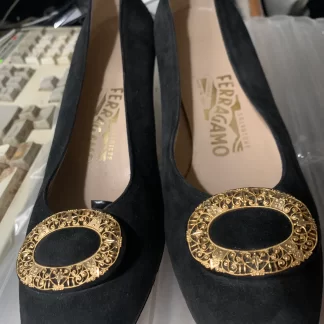
Salvatore Ferragamo Suede Pump with gold-tone oval buckle
Sale! Original price was: $325.00.$125.00Current price is: $125.00. Quick ViewAdd to cart
Showing the single result